
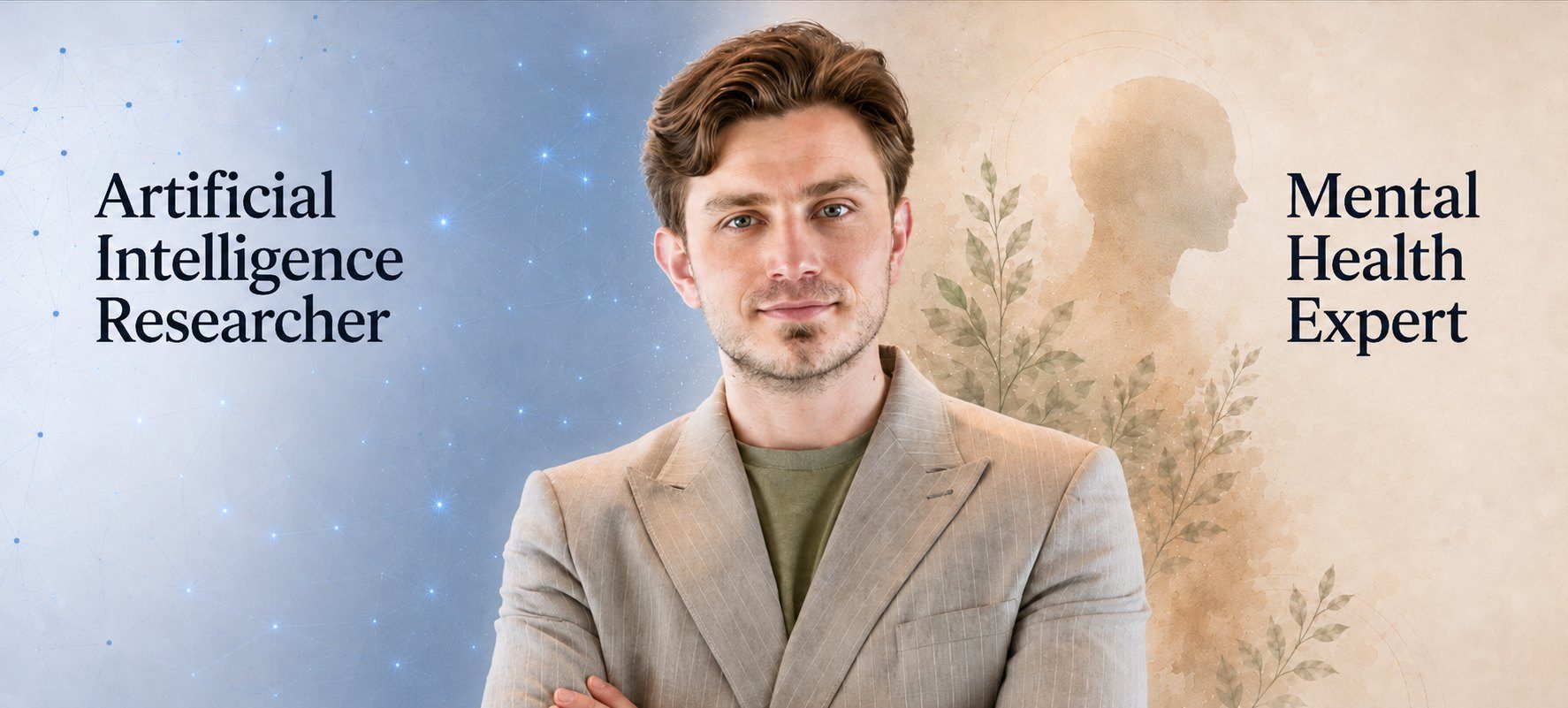
Mental health expert · two books · EFPA Project 13 · professional roots in three countries
Mental health expert · two books · EFPA Project 13 · professional roots in three countries
In Between
I grew up in Mischos, a village near Komotini. My childhood passed between two languages, two shores, two senses of belonging. From those years I never forgot one early lesson. Some voices reach the table late. But the weight they carry is real.
That is part of why I turned to mental health.
Understanding a person comes before trying to change them. Because no one heals while they feel unseen. Over the years, this is what the therapy room taught me most. Without a safe relationship, no deep change should be expected. A person first needs to be understood. The language of change usually opens only after that.
Today I ask the same question again, in the age of AI.
People now tell their most fragile thoughts to a screen as well. Their loneliness, their fears, their shame, their decisions, and sometimes the sentences they could never say to anyone, they share with digital systems. My concern is not to romanticize this encounter or to block it, but to help it move forward from a place where it is genuinely useful to a person. My aim is to make visible the human and clinical boundaries that must be protected around this new space.
Transparency.
Accountability.
Ethical responsibility.
Clinical care.
And the human bonds that no automation can replace.
The therapy room and the research desk are not two separate worlds for me. One listens to a person's real pain and their real voice. The other teaches me to rethink that voice within the language and the tools of the age.
This is why my work stands not between the two fields but exactly at their intersection.
Mental health and artificial intelligence. The most fragile places in a person, their pain, and technological change.
Because ages change, tools change, professions are transformed. But the human need to be understood, to be seen, and to heal inside a safe bond does not.
One need seats me at both desks: that a person finds somewhere to speak, and does not have to carry the weight of what they are going through, or the wearing side of healing, alone.
This site was built on the two shores of that very need.
On one side, mental health. On the other, artificial intelligence research. And in the middle, the human still stands.